


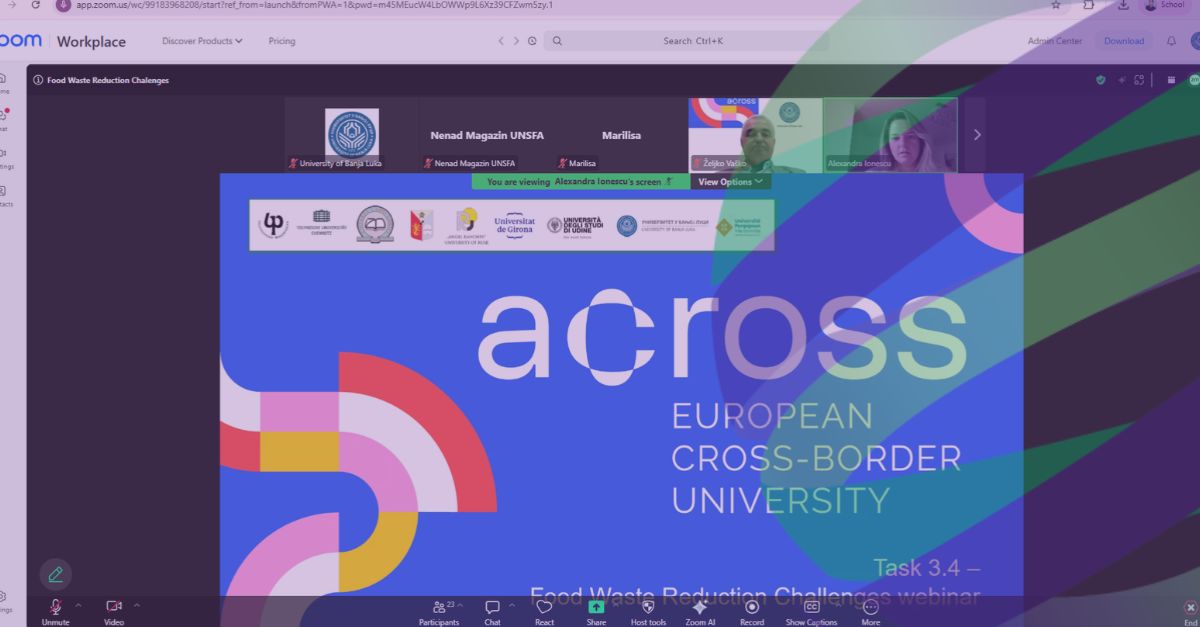
INTERNATIONAL WEBINAR ON FOOD LOSS AND WASTE
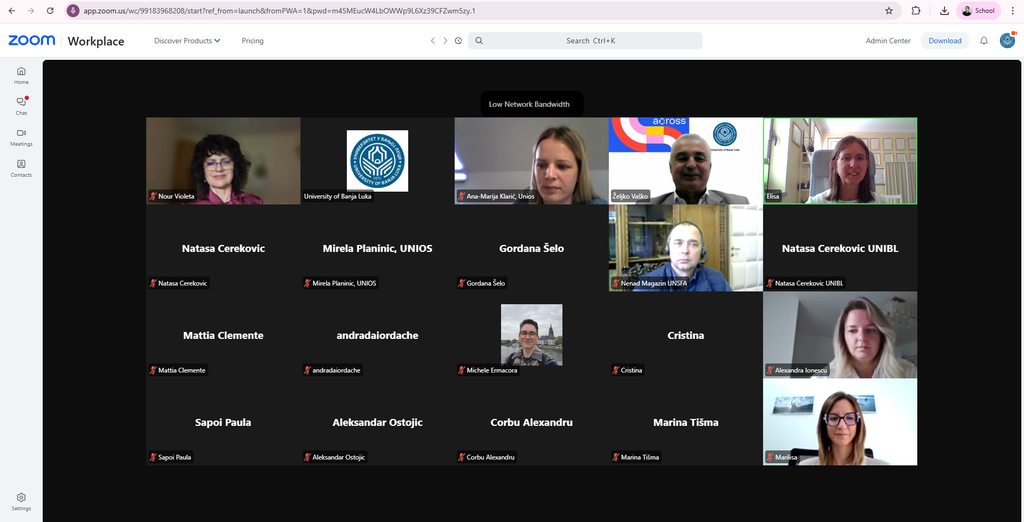
On the occasion of International Day of Awareness of Food Loss and Waste, the University of Banja Luka hosted an international webinar bringing together experts, researchers, and students to find sustainable solutions to one of today’s greatest environmental and economic challenges.
The event was organized as part of the BEAMING project and the alliance. Through a series of six lectures, participants were introduced to the entire food journey—from field and harvest, across market shelves, all the way to households and innovative laboratory solutions for its reuse.
Prof. Željko Vaško, PhD, from the Faculty of Agriculture at the University of Banja Luka, highlighted that globally, 13.3% of food is lost before reaching retail, while an additional 19% is wasted in stores, restaurants, and households—where as much as 60% of total food waste is generated. Beyond financial losses, these waste streams leave a massive carbon footprint and strain natural resources.
Marilisa Alongi, PhD, from the University of Udine (Italy), clarified the scientific distinction between the “use by” label, which refers to food safety, and “best before,” which indicates how long food retains optimal quality. Understanding this difference is the first step toward reducing the unnecessary disposal of edible food in households.
Alexandra Ionescu, a PhD student from the University of Craiova (Romania), demonstrated how impulse buying, promotional marketing, and a lack of meal planning lead to excessive food accumulation that ultimately ends up as waste, pointing out that changing individual mindset is a crucial driver for progress.
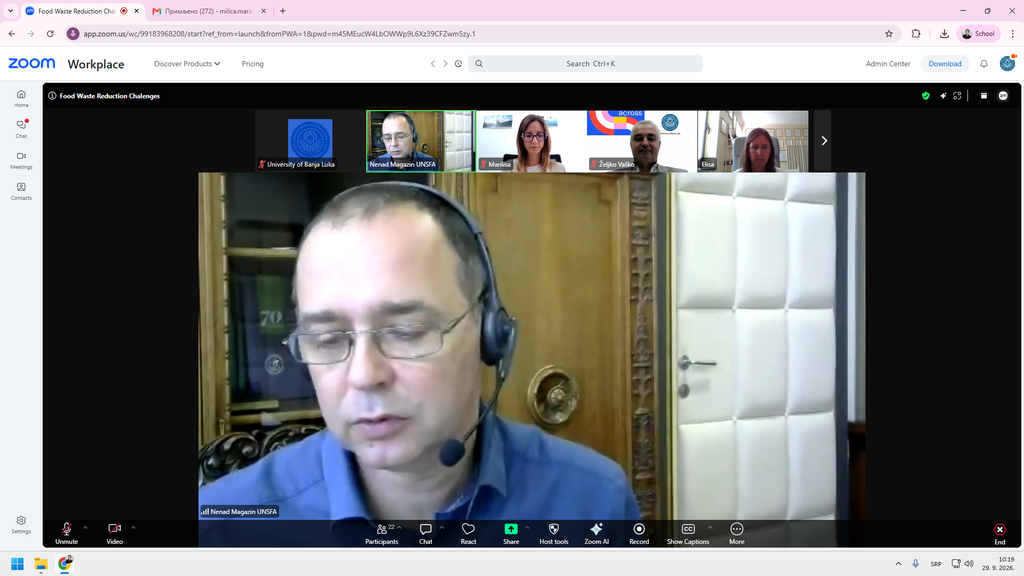
To ensure food reaches consumers fresh, post-harvest technologies play a decisive role, as discussed by Prof. Nenad Magazin, PhD, from the Faculty of Agriculture at the University of Novi Sad. He vividly explained how rapid cooling, maintaining an uninterrupted cold chain, and proper storage preserve the freshness and nutritional value of fruits and vegetables, preventing losses in the earliest stages of distribution.
Inspiring solutions from circular economy and value creation from waste were presented by Prof. Violeta Nour, PhD, from the University of Craiova (Romania). She showcased how fruit processing byproducts—such as apple and berry pomace—can be repurposed to enrich bakery and confectionery products with bioactive compounds, fiber, and antioxidants.
The final presentation was delivered by Ana-Marija Klarić, a teaching assistant at the Faculty of Food Technology Osijek (Croatia), who introduced the concept of upcycled food. Through a case study on the valorization of sugar beet pulp using the Ganoderma lucidum fungus, she demonstrated how solid-state biotechnological fermentation processes transform an industrial byproduct into a nutrient-rich ingredient packed with proteins and amino acids.
The event concluded with a clear message: reducing food waste is not only a technical and economic challenge, but a shared responsibility uniting science, industry, and every individual.


Leave a Reply